Naval Reactors For AI Data Centers
Commerce Scretary Lutnick appeared on Fox News, discussing new energy for data centers.
As we have noted previously, energy prices continue to spike near data center facilities across the US. Lutnick claimed data centers are going to provide additional power generation and capacity to the grid along with the construction of their facilities to lower the energy prices, but so far this has not been the case.
The additional costs of infrastructure to the wider grid that come with higher demand are not covered in the higher rates paid by the hyperscalers. Many of the costs extend to equipment outside of the immediate vicinity of the new power consumer, such as upgrades and maintenance to upstream transformers and powerlines. Maybe the rest of the US should copy what Texas does…
Make “behind the meter” mandatory https://t.co/ZEcmX5Ge0e pic.twitter.com/bCBnwx2E5g
— zerohedge (@zerohedge) December 24, 2025
And while multiple companies and developers are working on solutions for on-site, “behind-the-meter” power for AI data centers – with little practical success to date – one power developer has formally proposed an idea that has been informally discussed for years.
HGP Intelligent Energy, a Texas power developer, is proposing to use reactors from US Navy submarines and aircraft carriers to power a data center project in Oak Ridge, Tennessee. The company claims redirecting two retired naval reactors could produce about 450-520 MW of power in what would be the fastest way to add new baseload power to the grid while the commercial nuclear industry struggles to get back on its feet.
The likelihood of this proposal being accepted by the US government is extremely low unless custody of the reactors is retained by the DoE, which is what HGP currently recommends in their proposal. Naval reactors have multiple differences compared to traditional commercial reactors, most notably the extremely high enriched uranium content, which is over 90%, compared to traditional reactors which are less than 5%
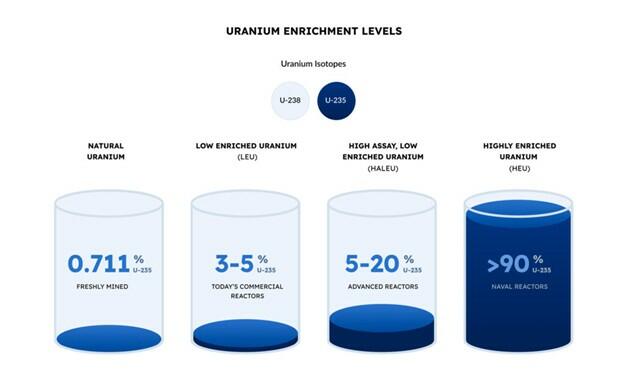
In addition to concerns about proliferation of weapons grade uranium, there are also concerns of how the reactors can operate after they are removed from their submarines or carriers. The reactors are either removed from their vessels and decommissioned due to no longer being able to operate as designed at their old age, or sometimes due to the decommissioning of their host vessel. There are likely multiple headaches with operating the reactor in its aged status with respect to reactor physics and material integrity. Just sticking lower enriched fuel inside a reactor designed for highly enriched fuel could prove difficult, as the geometry of the core alone may not allow for proper operation.
Still, the recommendation of involving the nuclear navy with the reinvigoration of the nuclear industry does hold value. The Naval Nuclear Propulsion Program is the most successful nuclear program in history, with over 7500 reactor years of safe operation. Their expertise with reactor plant construction and operation would likely benefit the commercial nuclear industry in multiple ways.
Tyler Durden
Wed, 12/24/2025 – 14:40